Software Tools for Drug Discovery, Computational Chemistry and Artificial Intelligence
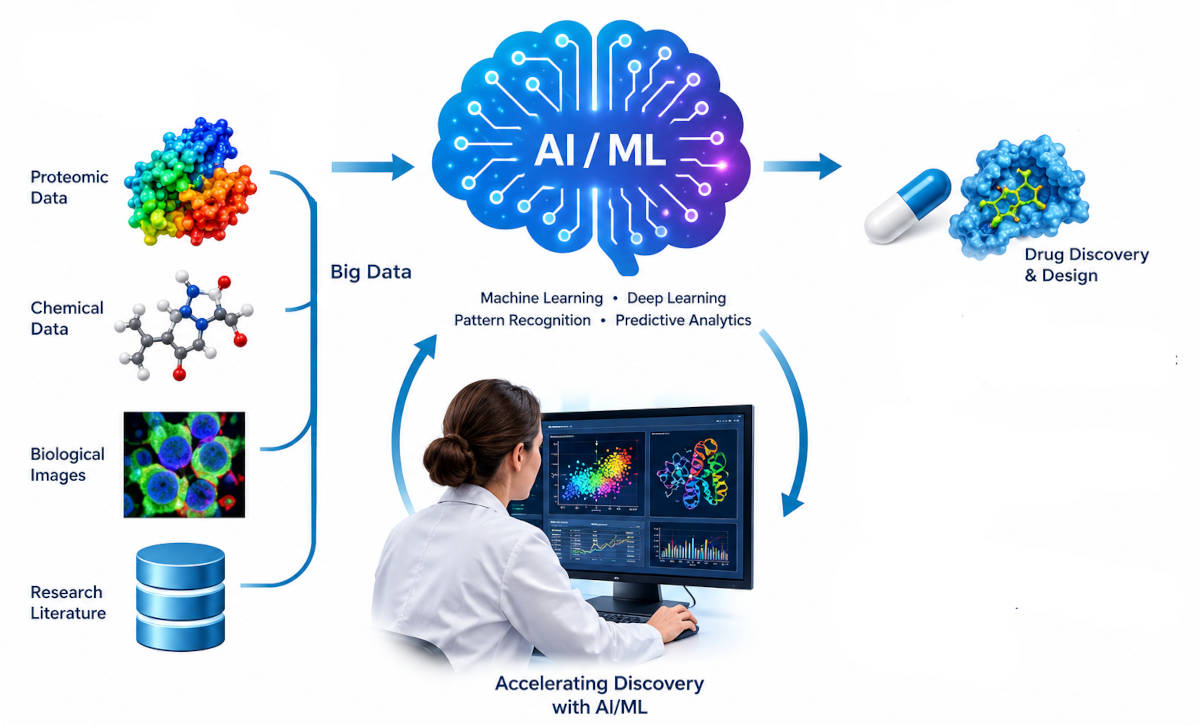
The following are links to software resources to help those researching new drugs and therapies. Computer simulation of chemical reactions allow for the quick turn-around of iterative trials and experimentation. The suite of software tools range from simple modelers, viewers and analysis to Artificial Intelligence (AI) driven drug simulations and discovery. Open source (free cost and licensing) and commercial solutions (pay for a licensed corporate supported product), are listed.
The AI Stack:
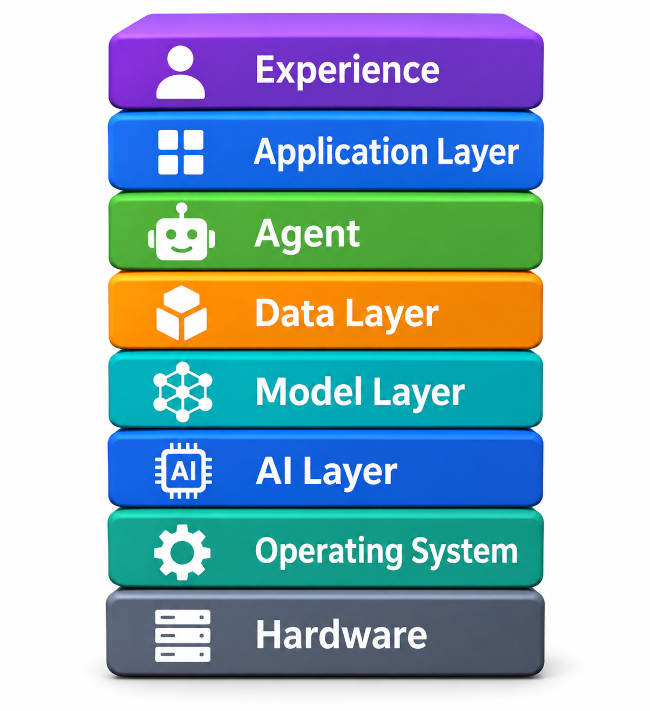
The "stack" refers to the layers of technology used to provide a solution. For example, an AI stack implementation would most probably consist of a physical hardware layer (with CPUs, GPUs, TPUs) at the base, followed by an operating system layer (usually a virtual machine (VM) instance of Linux OS). The hardware and OS layers are typically provided by cloud providers such as Amazon AWS, Microsoft Azure or the Google Cloud Platform (GCP). Local hardware and OS are also an option.
This is followed by an AI layer (typically PyTorch, Tensor Flow or JAX) configured as a model layer (where AI interfaces with a language, image, video or computational chemistry model) coupled with a data layer used for training or inference. The model and data layers then talk to an agent or perhaps an application layer, to communicate with the outside world. This final layer is known as the experience layer.
The simplest invokation of AI is to use an exisitng trained (data already ingested, processed and integrated) AI instance from HuggingFace.co. Existing open source models for natural language exchange are prolific and available for general and very specific use. Models which work to solve physics and chemistry problems are in their infancy but available. Commercial implementations are available from their vendors.
AI Layers:
- Experience Layer: the user interface - web, mobile phone or human GUI interface
- Application Layer:
- Agent: includes workflow and planning orchestration
- Data Layer: data retrieval protocols and model training. Look at MCP, a universal protocol for data connectivity.
- Model Layer: foundation models built with AI SDK.
- AI Layer: This is model management, service management, SDK, developer tools platform.
The following AI engines are among the most popular in use:
- PyTorch: an open-source deep learning library, originally developed by Meta Platforms and currently developed with support from the Linux Foundation. Written in Python and C++.
- TensorFlow: an open-source, end-to-end machine learning platform developed by the Google Brain Team. Supports Google Tensor Processing Units (TPUs) hardware.
- JAX: Google's next generation AI framework focusing on performance.
- Operating System: This is typically Linux and is usually restricetd to one of the popular distributions such as Ubuntu or Red Hat (or one of its clones: CentOS or Fedora. The cloud providers often make a preferred distribution. For example Amazon AWS provides a Red Hat based Linux distribution.
- Hardware: The hardware layer includes the computing, networking and storage capability.
The computer hardware layer requires a choice of CPU architecture, size of memory, architecture and size of GPUs (eg. graphics matrix math), TPUs (Google Tensor flow, Amazon Trainium).
CPU choices are typically between Intel and AMD x86-64 architecture or ARM.
ARM, while prolific in the cell phone market, is being adopted by cloud servers due to their very low power consumption.
Power consumption matters when the scale is of thousands of servers in a data center.
The amount of memory must reflect the needs and abilities of the CPU as well as the needs of the AI model.
Chemical, Molecular and Biological Databases:
Many online database libraries of molecules and proteins have been created as shared resources to be employed and integrated with software tools used for simulation and development.
- NIH:
- PubChem - chemical information
One can also download current chelator compound digital models (DMSA, DMPS, NBMI, ALA, MiaDMSA, Glutathione, etc) - NIH: Chemical structures database (chemical and molecular models including nucleotides, carbohydrates, lipids, peptides, chemically-modified macromolecules, etc)
- Chemical Identifier Resolver
This service works as a resolver for different chemical structure identifiers and allows the conversion of a given structure identifier into another representation or structure identifier.
It can help you identify and find the chemical structure if you have an identifier such as an InChIKey.
This portal is also capable of generating ("convert to") a SMILES representation for a molecule.
You can either use the resolver web form above or use the following simple URL API scheme: https://cactus.nci.nih.gov/chemical/structure/"structure identifier"/"representation" - NCATS - An open-science platform that shares real-time drug screening data, protocols, and chemical datasets for emerging public health needs and other diseases.
The National Center for Advancing Translational Sciences (NCATS) provides several key public databases and data portals to support preclinical research, drug discovery, and clinical studies.
- PubChem - chemical information
- CDD Group Chemoinformatics Tools and User Services - long list of online tools and services
- ZINC-22 - database
- VAE: A SMILES Variational Autoencoder - a deep learning model that translates discrete molecular structures written in SMILES format into a continuous numerical string for automated drug and material design.

Molecule Builders, Editors and Viewers:
- VMD: Visual Molecular Dynamics - molecular visualization and animation. Free open source for MS/Win, Mac and Linux. Like Avogadro but more sophisticated.
Ubuntu install: sudo apt-get install vmd - PyMol - molecular visualization and animation. Free open source for MS/Win, Mac and Linux. Maintained by Schrödinger.
- Avogadro - free open source for MS/Win, Mac and Linux. Define, model and visualize 3D molecules. Interfaces with many computational chemistry tools.
Ubuntu install:- sudo apt-get install openbabel
- sudo apt-get install avogadro
SDF: Structure Data Format:
SDF: Structure Data Format - text based chemical structure data fileSoftware which can read SDF files:
- Avogadro - free open source for MS/Win, Mac and Linux. Define, model and visualize 3D molecules. Interfaces with many computational chemistry tools
- DataWarrior - free open source
- OpenEye Scientific VIDA
- iMol - free open source
- Jmol - free open source Java based viewer for 3D chemical structures, vibration frequency mode animations, etc
- IQmol - free open source. MS/Win, Mac, Linux. Generate models of molecules.
- Molekel - free open source
- ChemSpotlight - free open source
- Open Babel - free open source
- SDFReader - free open source
- OpenBabel - toolkit designed to convert, search, analyze, and store molecular data across over 100 chemical file formats (such as PDB, SDF, MOL2, CIF, SMILES, InChI).
Supports molecular analysis and coordinate generation.
Integrated with many viewers, editors and tool chains.
Ubuntu Linux install: sudo apt-get install openbabel - Progenesis SDF Studio - A free tool to view, merge and repair SDF and MOL files.
Avogadro: Import molecule:
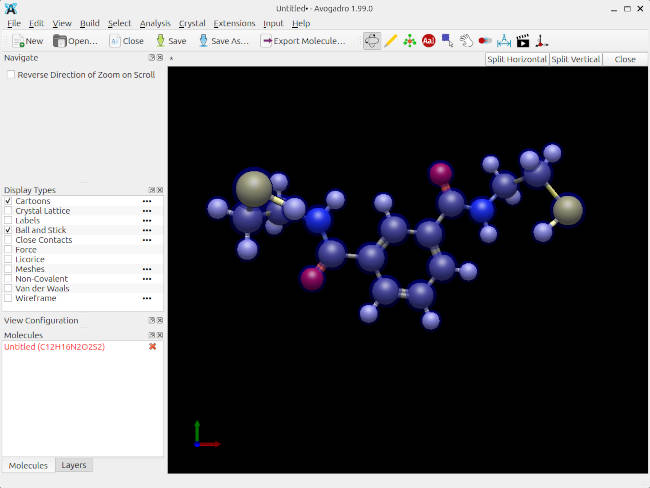
Use NIH chemical identifier resolver to take chemical name and generate SMILES representation (ex. NBMI)
Returns error in number of double bonds in carbon ring:
SCCNC(=O)c1cccc(c1)C(=O)NCCS
In Avagadro, select "Build" + "Insert" + "SMILES" and enter text string.
Build geometry by hand in avogadro, export xyz file. Use babel to convert to SMILES: obabel input.xyz -osmi
Returns: c1ccc(C(=O)NCCS)cc1C(=O)NCCS
Geometry: "Extentions" + "Open Babel" + "Optimize Geometry" will find low energy geometry.
Colors:
- Dark Blue/Black: Carbon
- Blue: Nitrogen
- Yellow: Sulfur
- Red: Oxygen
Software Models and Resources:
Tinker toy chemical models have been replaced by 3D computer models. Even analytics are automated with purpose built data analysis tools.
- Google AlphaFold - pairing DeepMind AI and protein folding
- AlphaFold Protein Structure Database (EMBL-EBI)
- Fold.it - visual protein folding software for protein research and design
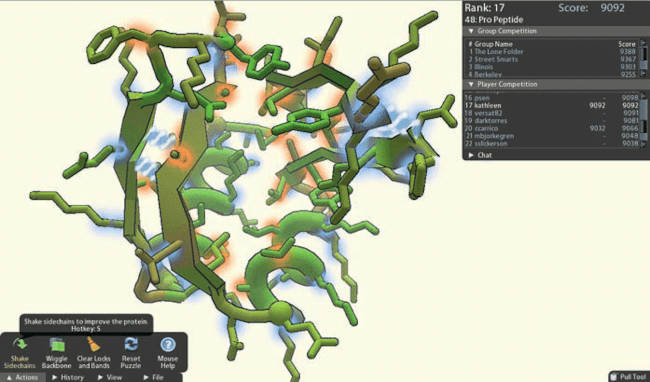
FoldIt
Computer-Aided Drug Design (CADD) software:
CADD software tools are ideally suited for the discovery, simulation and optimization of new medical treatments. CADD tools allow for the simulation of chemical reactions, compound optimization, compound discovery, virtual screening (VS) and high throughput screening (HTS).
With the current generation of software tools one can simulate the pharmacokinetics and model the clearance mechanisms using ECCS (Extended Clearance Classification System), model the Blood-Brain-Barrier (BBB) permeability, predict solubility and test for drug-drug interactions (transporter inhibition where transporter-in models the stomach and transporter-out include kidneys and the liver).
Open Source Computational Chemistry Software:- GROMACS - open-source software suite for high-performance molecular dynamics and output analysis.
- ORCA - quantum chemistry, coupled cluster calculations
- Rosetta - Open source but licensed.
- Swiss-Model - 3D protein modeling
works with other tools:- Blast - compares protein sequences to sequence databases
- HHBlits - iterative protein sequence searching
- MolProbity - validation for 3D structures of proteins
- HPEPDOCK - predict complex structure between a protein and a peptide
[server] - HDOCK server - Protein-protein and protein-DNA/RNA docking
- MOPAC: Molecular Orbital PACkage - semiempirical quantum chemistry - free open source for MS/Win, Mac and Linux
- AutoDock Vina - open-source program for simulating molecular docking and how molecules and drug candidates bind to a protein and estimates their binding affinity. It was originally developed at The Scripps Research Institute. Also requires AutoDock Tools for viewer and support tools.
- GAMESS: General Atomic and Molecular Electronic Structure System - quantum chemical calculations. Many code forks exist with huge differences. Free open source for MS/Win, Mac and Linux
- LAMMPS - for solid-state materials (metals, semiconductors) and soft matter (biomolecules, polymers) and coarse-grained or mesoscopic systems.
ORCA and Gaussian tend to be more accurate. MOPAC and GAMESS tend to be less computationally demanding.
Commercial Computational Chemistry Software:
- Schrodinger: Maestro - computational chemistry, molecular design, drug formulation and visualization
Often teams with pharma drug development programs. - Biovia (Dassault Systemes):
- Biovia Discovery Studio - biological and physicochemical 3D modeling and simulation
- Discovery Studio Visualizer - free download for MS/Win and Linux
- Biovia Materials Studio - Chemical and Catalyst R&D
- Biovia Discovery Studio - biological and physicochemical 3D modeling and simulation
- Wavefun: Spartan - computational chemistry and visualization
- Cresset - computational and medicinal chemists
- Pharmacelera
- OpenEye Scientific
- Chemical Computer Group
- Acellera
- Gaussian - molecular mechanics, quantum chemistry, coupled cluster calculations
- Suite of open source computational chemistry software: OpenChemistry.org - Avogadro, MoleQueue + MongoChem and Tomviz
- Optibrium - drug discovery, design, optimization
Software and resources for computational medicinal chemistry - see table 6 (2012)

Protein Database: Cryo-EM structure of alpha-synuclein H50Q Narrow Fibril
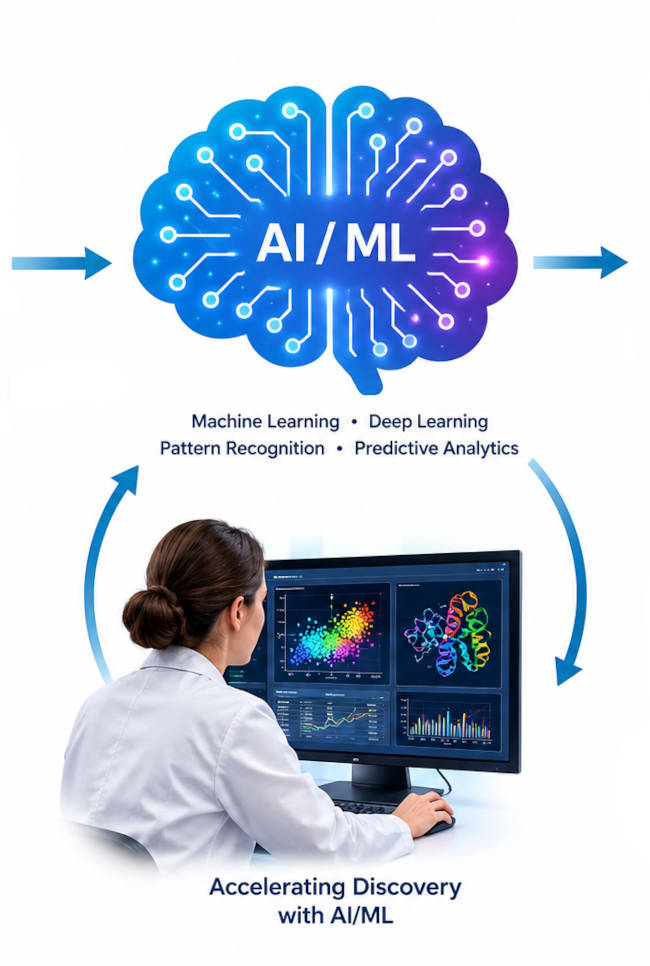
Artificial Intelligence (AI) Machine Learning (ML) Software:
- Reinvent - reinforcement learning-driven generative chemical language model developed by Astra Zeneca's Molecular AI group for de novo design and multi-objective molecular optimization
- Astra Zeneca - Molecular AI - Reinvent4 and tools
- Lecture on drug design using AI - overview of Reinvent by Jon-Paul Janet
- Schrodinger: Bunsen - Where validated physics meets AI
- Schrodinger FEP - Free Energy Perturbation Plus is a physics based computational software tool used in drug discovery to predict binding affinities and molecular properties
- Lily: TuneLab - Lilly proprietary foundational AI/ML models, web-based interface that facilitates rapid model interrogation via direct input of SMILES strings.
- IBM/MoLFormer - chemical language model designed with the intention of learning a model trained on small molecules which are represented as SMILES strings. Train on public chemical datasets PubChem and Zinc.
Also see MoLFormer-XL - pretrained AI model that infers the structure of molecules from simple representations - IBM/MAMMAL - Molecular Aligned Multi-Modal Architecture and Language, a biomedical foundation model developed by IBM Research to transform AI-driven drug discovery
To download an existing AI model loaded with training datasets, see HuggingFace.co
AI machine learning software requires a lot of chemistry data in order for it to "learn". Existing molecules may also be required to study interactions. Also, compounds developed can be shared digitally in public databases:
- ChEMBL - database of bioactive molecules with drug-like properties. ChEMBL primarily stores compound-target interactions (how a small molecule binds to a protein or biological target) rather than direct patient drug-drug interactions.
- PubChem - chemical information
One can also download current chelator compound digital models (DMSA, DMPS, NBMI, ALA, MiaDMSA, Glutathione, etc) - BindingDB - molecules with drug-like properties and their binding affinities
For a more complete list of chemical databases see Chemical, Molecular and Biological Databases
Also see SMILES - specification in the form of a line notation for describing the structure of chemical species using ASCII strings. SMILES is the chemical notation used with AI ML software.
Terms and Acronyms:
| Term or Acronym | Description |
|---|---|
| CADD | Computer-Aided Drug Design: software tools which allow for the simulation of chemical reactions allowing for the quick turn-around of iterative trial and experimentation. |
| De Novo Design | The process of creating completely new molecules, proteins, or drugs from scratch using physical rules and computers, rather than copying existing natural templates. |